(Originally posted on Seventy-Magazine.com, translated in Dutch for MarketingFacts)
Around ten years ago, when you used a urinal in a popular bar or cinema in Europe, chances were you had an advertisement poster in your view, with a big QR code in the lower right corner. Western marketeers used the QR code primarily to redirect people to their advertisements or websites for more information on their product, which nobody really did, because nobody cared. Not only was the intent wrong (I don’t want to see your advertisement), the timing and place was wrong too (I’m taking a leak). The QR code became a joke, most apparent in the blog ‘Pictures of People Scanning QR Codes‘, which is is jokingly empty.
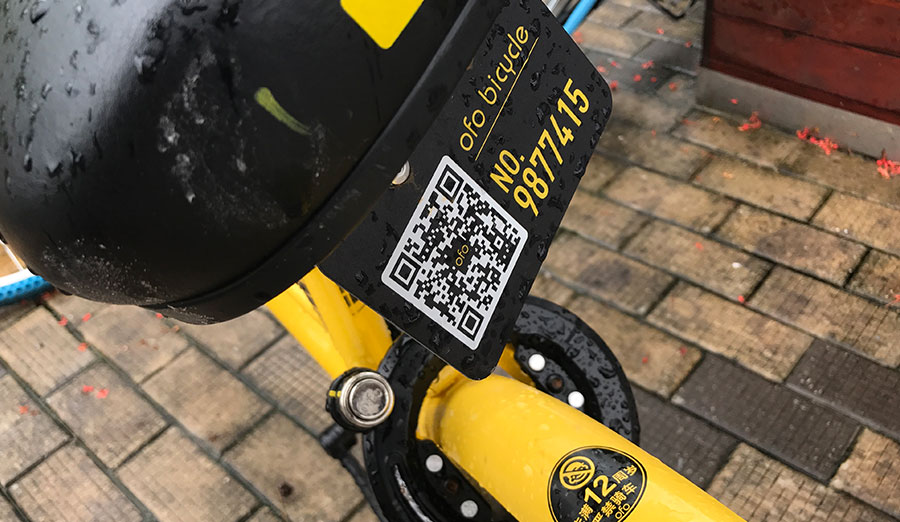
But QR codes in China carry none of that stigma. They’re really useful, and they’re instrumental in ditching cash and plastic card payments. You use them for paying, unlocking bikes, opening the menu, visiting an online store. You see them on counters, tables, on sharing bicycles, karaoke booths, laundry machines, vending machines, apps, coffee cup sleeves, armrests of high speed trains.
They work both ways. Let’s say you’re paying at a convenience store. You can scan the stores’ QR code and enter the amount to transfer, and show to the cashier you’ve paid, but you can also generate a QR code on your phone which the cashier can scan. Apps like Alipay can even generate these codes without an active internet connection. You add people to your social network by scanning their QR (with that said, here’s mine for WeChat), you use them to verify your identity on websites, and you pair smart devices to your smartphone by either scanning their QR code, or having them scan yours on your phone.

Use of QR codes is so widespread that street vendors also have QR codes, printed and laminated and ready for use. Some street signs have QR codes that show the nearest police station. And my favourite example is the below photo of street musicians in Xi’an, who don’t have an empty guitar case for money collection, but just show their QR codes instead.



I think the biggest lesson in this is that technology is used for the consumers’ benefit. This was never the case in the West and I wonder if there the QR code will overcome its false start. Instead, the West seems to opt for NFC tags for paying, which is superior in some ways, less accessible and this is exactly what might hinder a widespread rollout.
QR codes in China became so popular and mainstream in their use because of accessibility. Everyone could print one, and you could show them on screens and inside apps, merging off- and online so well (more on that in ‘Contextual thinking, contextual marketing‘). If your phone has a camera, that’s enough (whereas not all phones have NFC).
It’s important to realise we’re not talking early adopters here. Last year, more than 65% of China’s population used mobile payments, and the percentage is much higher in top tier cities, where many stores don’t accept cash or card payment. Even my Chinese mother-in-law uses QR codes and it amazes me, but she treats it like its the most normal thing in the world.