Learning Chinese, or any language, makes you more aware of language in general. And one thing that surprised me is that, despite Mandarin being so different from my mother tongue (Dutch), both languages reach for the same units when weighing things: the kilogram (公斤, gōngjīn) and the half-kilogram (斤, jīn).
It’s a small thing, but it got me wondering how these two cultures separated by a continent and a few thousand years of history, somehow landed on the same way to weigh a bag of rice. Once I noticed it, I started seeing it everywhere.
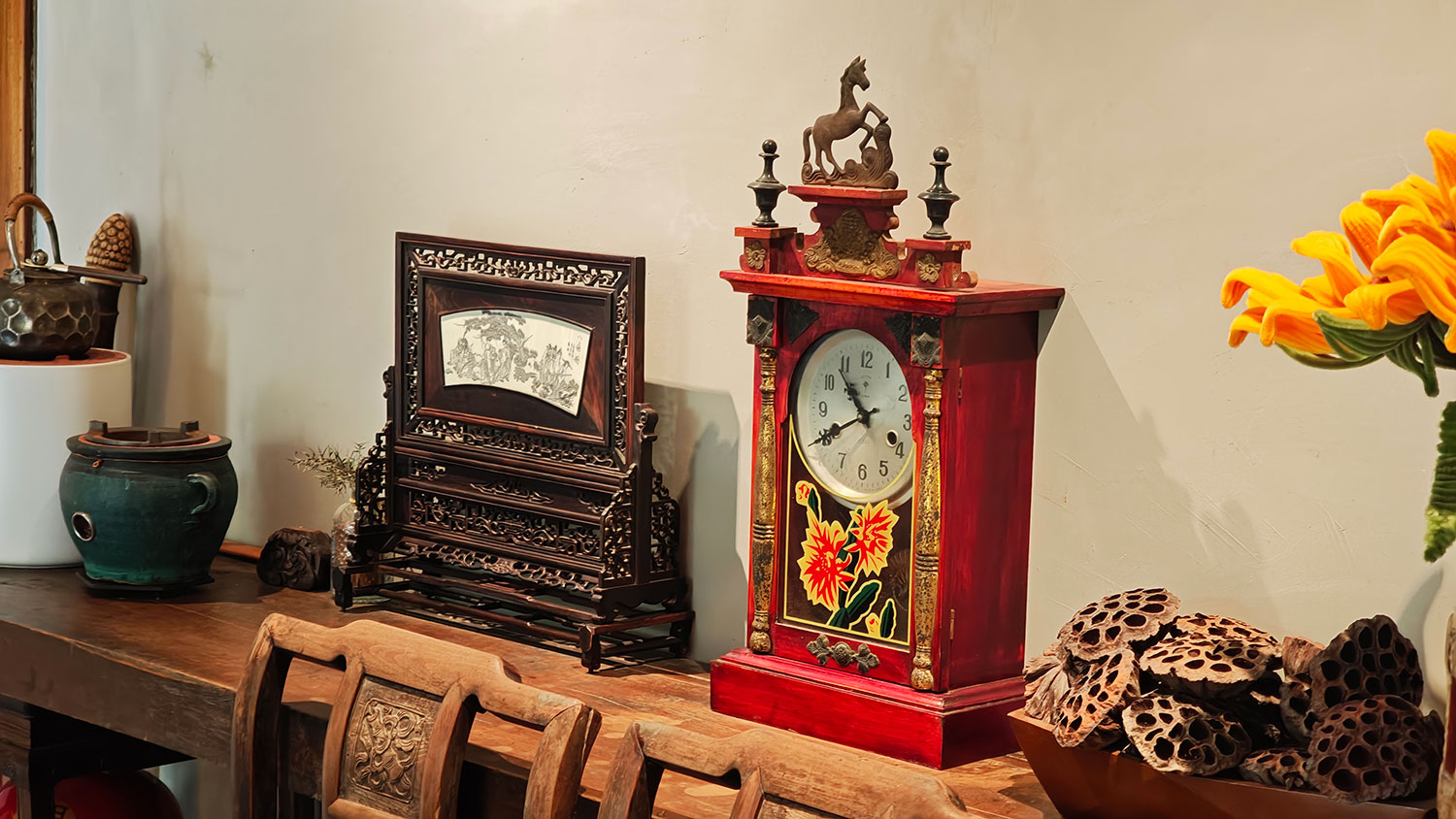
Take time. The original 时 (shí) was 120 minutes, not one hour, so a single day held just 12 时’s — each carrying a zodiac animal, the same twelve you find in the years. The switch to the Western clock came gradually: mechanical clocks arrived with Jesuit missionaries around 1600, spread through the late Qing, and the 24 hour day became standard in the early Republic after 1912. And the changeover left a trace in the language. The modern word for “hour” is 小时 (xiǎoshí) — literally “small hour” — because when the 60-minute Western hour replaced the old 120-minute one, it was, quite simply, half the size. Every time someone in China says “hour,” they’re still quietly measuring it against a unit that hasn’t existed for a century.
And living in China, you’ll notice that Chinese people prefer the jīn over the gōngjīn. So when I say I’m 75 kilo (75公斤), the reply comes back “Aha, 150 jīn”. But it’s remarkable nonetheless, for such an ancient language — because “closer” countries like the United Kingdom and the United States can’t even agree with the rest of the world to use the full metric system. I genuinely have no idea how tall a 5 foot 11 person is. The jīn, at least, sits closer to the kilo than the pound does.
So is it a coincidence that China’s system fits the kilogram so neatly? Or did everyone, eventually, drift toward the same round numbers? I’m not a professional historian but I was curious enough to explore these.
Measuring weight
The jīn has come a long way. We can trace it back to the Qin Dynasty (221–206 BC), and it was reformed in 1929 to line up with the kilogram. Before that, one jīn weighed 596.816 grams. (If that number looks oddly specific — why 596.816? — remind yourself that the weight of “one gram” is fairly arbitrary too. A gram is just one-thousandth of the mass of a liter of water, a definition someone chose; nature didn’t hand it to us.)
The original jīn was built on 16 liang (两, liǎng). You still hear it in the idiom 半斤八两 (bàn jīn, bā liǎng) — “half a jīn is eight liǎng” — meaning two things are basically the same.
The liang has a long, fuzzy history. It’s also called the tael, a word that — like Mandarin itself — travelled from Malay through Portuguese and into English. The jīn, meanwhile, often goes by catty.
The tael starts with an object you may have seen in a museum or in an old family’s home: the yuanbao (元宝), literally “valuable treasure.” These silver or gold ingots were first used as payment in the Qin Dynasty. The shapes varied wildly — square and oval, but also boats, flowers, turtles, and the common horse-hoof form (马蹄金) — and eventually coins grew popular too. What mattered was the weight, which was measured in liang.
The yuanbao was further systematised during the Tang Dynasty (618–907). This was also when paper money kept drifting in and out of favour thanks to fraud and wild fluctuations, which made the yuanbao the more reliable currency — right up until the end of the Qing Dynasty (1644–1912).
The weight of silver and gold
Yuanbao were measured in liang, but how much a liang actually was varied by province, by town, and sometimes by the day. The differences were small, but the confusion was real — imagine settling a debt across two towns and arguing over whose liang counts. There was the Caoping (漕平, cáopíng, the canal-shipping standard) at 36.7 grams of slightly less pure silver; the Qianping (钱平, the money standard); and the Shiping (市平, the market standard), which again shifted from city to city, day to day, and depending on who you were talking to.
By the Qing Dynasty, the Kuping (库平) or ‘warehouse standard’, was the one to go by. Markets and merchants kept their own scales — the ones now sold as “traditional medicine scales” or “opium scales.” In 1908 the Kuping was finally standardised nationwide, fixing one liang at 37.5 grams. Common amounts were 50, 10, 5 and 1, with a single yuanbao often coming in at 50 Kuping.
Kuping meets the metric system
All this while, the jīn stayed loosely tethered to the liang, hovering somewhere between 500 and 600 grams. But the country was in motion, and so were its weights. With foreign trade booming, the Beiyang government (北洋政府) declared in 1915 that the metric system would run in parallel with the Kuping. In 1929 the Nationalist Government went further and fully adopted the metric system, rounding the old Kuping figures to clean metric numbers, and reserving the Kuping standard only for private sales and trade. One jīn became 500 grams, and since one jīn equalled 16 liang, one liang was set at 31.25 grams.
The old market system kept running alongside the metric one, of course, as it still does today — especially for gold, silver, and Chinese medicine. Then in 1959 the government declared that one jīn would no longer hold 16 liang but 10, pushing the liang up from 31.25 to 50 grams.
So now we have:
- 1斤 = 10两 = 500g
- 1两 = 50克 = 50g
Which means that while you still hear 半斤八两 (half a jīn is eight liǎng), it isn’t even true anymore. Five liang would do it now. The yuanbao, though, still matters, but not its weight: imitation-gold ingots decorate cabinets and reception desks, and during the Zhongyuan Festival (中元节), paper yuanbao are burned at ancestors’ graves.
Measuring length
Like weight, length switched to the metric system in 1929. And like weight, the traditional units had an equally twisty past — not just their precise lengths shifting over time, but the ratios between them, and all of it varying by region.
Most of these units originate from the body itself, like the cùn (寸), the width of a thumb at the knuckle. Handy, because everyone carried two rulers with them at all times. Two forefingers made 1.5 cun; four fingers side by side made 3. It’s the same logic that gave English the foot and the inch — bodies are the one measuring tool nobody forgets at home.
But body units were too inconsistent (whose thumb?), and according to legend it was Yu the Great (大禹), who lived around 2123–2025 BC, who unified them. Archaeologists have found decimal-system rulers as far back as the Shang Dynasty (1600–1046 BC), and excavations from later dynasties trace how the measurements shifted across the centuries, usually with the chi at the centre.
Chi, bu, and li
尺 (chǐ) literally means “ruler,” but is also called the Chinese foot. In the Shang Dynasty it was 0.1675 metres; by the Qing it had grown to 0.3352 — the unit nearly doubled in length over the centuries, which tells you just how slippery “a foot” can be.
步 (bù) means “step,” and equalled 6 chi until the Tang Dynasty, when it dropped to 5. This connected to 里 (lǐ), which refers to a village: 300 bu in the Shang Dynasty, 360 by the Tang.
Western influence
As trade with the West increased — willingly or otherwise — the 丈 (zhàng, equal to 10 chi) was redefined to 3.58 metres, which dragged the chi up to 0.358. This was written into treaties with England and France (1842–44 and 1858–60). But the real break, as with weight, came in the 20th century: in 1929 the chi was set at 0.333 metres, only a small adjustment from there.
The length units settled into:
- 一寸 (1 cùn) = 3.33 cm
- 一尺 (1 chǐ) = 33.33 cm
- 一丈 (1 zhàng) = 3.33 m
- 一里 (1 lǐ) = 500 m
And since the metre is now the everyday unit, it arrived as 米 (mǐ). This is what people use for height, so I’m “1米93” (1.93m) tall, and children usually have to be under “1米4” (1.40m) to ride a theme park for free.
That sparked a whole new family:
- 一毫米 (1 háomǐ) = 1 millimetre
- 一厘米 (1 límǐ) = 1 centimetre
- 一分米 (1 fēnmǐ) = 1 decimetre
- 一米 (1 mǐ) = 1 metre
- 一公里 (1 gōnglǐ) = 1 kilometre
Even the imperial units got names, built on 英 (yīng), from 英国 (Yīngguó, Great Britain):
- 一英里 (1 yīnglǐ) = one mile
- 一英寸 (1 yīngcùn) = one inch
- 一英尺 (1 yīngchǐ) = one foot
Cun, bu, chi, and zhang are barely used now, except in traditional medicine or trades like tailoring, where you’ll often see the 市寸 (shìcùn) — 市 (shì, “market”) marking it as the old unit rather than the modern one.
And even where the old units have faded, they live on in idioms:
- 一寸光阴一寸金,寸金难买寸光阴 (yī cùn guāngyīn yī cùn jīn, cùn jīn nán mǎi cùn guāngyīn) — a cun of sunshine is worth a cun of gold, but a cun of gold can’t buy back a cun of sunshine. Time is money, and then some.
- 老骥伏枥,志在千里 (lǎo jì fú lì, zhì zài qiān lǐ) — the old horse in the stable still longs to gallop a thousand li. An old soul with great ambitions yet.
I’m sure there are hundreds if not thousands of other fossils hidden in the modern Chinese language — and digging for them is a fun part of learning. Plus the fact that the Chinese and Western units met and merged, is its own small wonder.
Sources:
- https://baike.baidu.com/item/%E5%85%AC%E5%88%B6/10494605?fromtitle=%E7%B1%B3%E5%88%B6&fromid=2392312
- https://nl.istanbulseo.net/wiki/Chinese_units_of_measurement
- https://en.wikipedia.org/wiki/Catty
- https://www.chinasage.info/measures.htm
- https://daydaynews.cc/en/history/322757.html
- http://sunflower-recipes.blogspot.com/2010/05/half-catty-eight-taels.html
- https://www.youtube.com/watch?v=1yI3YnMNoMQ
- http://www.chinaknowledge.de/History/Terms/kuping.html
- https://en.wikipedia.org/wiki/Sycee#
- https://en.wikipedia.org/wiki/Tael
- https://app.ninchanese.com/word/%E6%96%A4
- https://www.quora.com/What-was-the-ancient-Chinese-unit-of-measurement
- https://www.britannica.com/topic/zhang-ancient-unit-of-measurement
- https://www.chinasage.info/measures.htm
- https://www.convertunits.com/from/chinese+inch/to/inches
- https://units.fandom.com/wiki/Traditional_Chinese_Units_of_Length
- https://en.wikipedia.org/wiki/Traditional_Chinese_timekeeping