This summer, I joined GoEast Mandarin‘s summer intensive course intended for students who finished HSK4. Here’s my brief recap and whether you should do it too.
Why Spoken Chinese and not HSK5?
Several reasons. First, I live in China, but I don’t need the HSK exam for my visa, nor am I studying at a university any time soon.
Second, I think HSK5 and 6 aren’t the best way to progress if I just want to make conversations in Chinese. That is also the advice GoEast Mandarin gave me. HSK5 consists of many literature words, whereas GoEast’s Spoken Chinese courses use real-life materials or books focussing on spoken language.
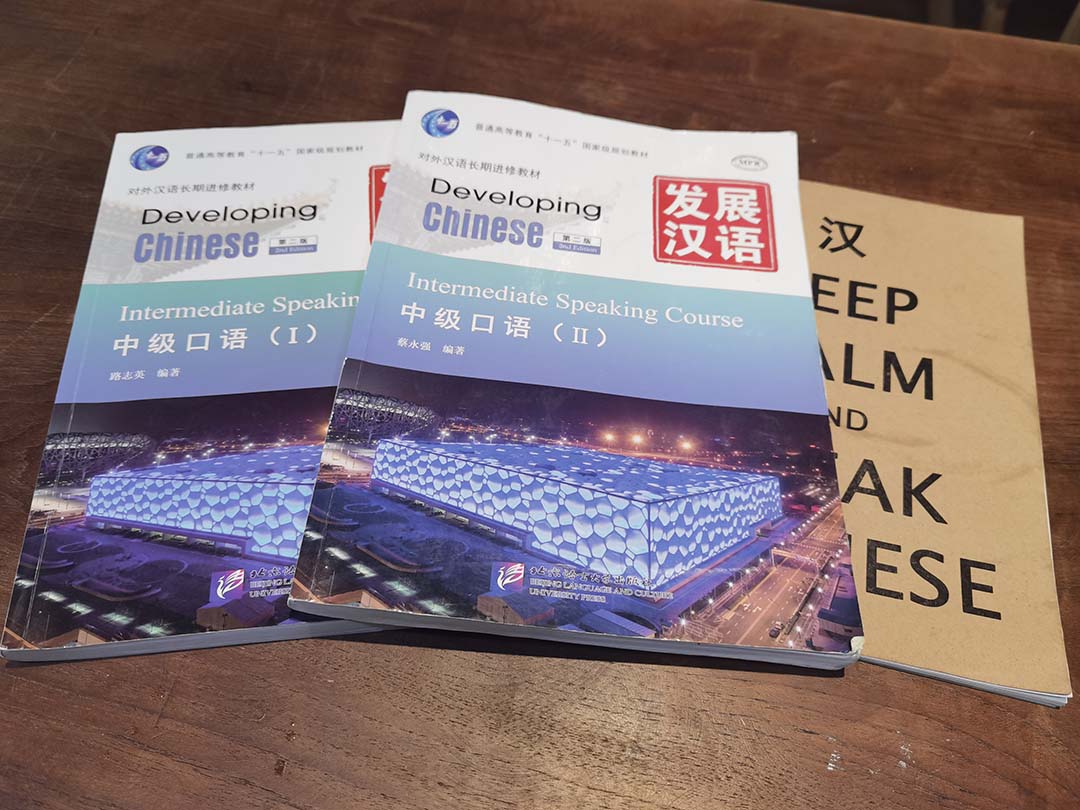
Before joining the summer course, I had already done around 70 hours of GoEast’s Spoken Chinese course, based on the 发展汉语,中级口语 books from Beijing Language and Culture University Press — and I will continue with these after the summer.
Summer course
We’ve done 48 hours of class, three times 2 class hours per week (Monday, Wednesday, Friday) at the Changle Lu campus. All under the guidance of Shishi老师, with Anna老师 also taking on some classes on Monday (when the group split in two).
Classmates
It’s been a while (Hanzi course, after HSK2) that I had classmates. I think the private class is faster, but group classes are more comfortable (and affordable), plus it’s nice to compare yourself with classmates. After HSK4, I think everyone’s level starts to diverge: some are good at reading, some have perfect pronunciation, some have good fluency (they speak without having to think too long), and others know a lot of words.
I learn a lot from classmates too, they will have a word in their rotation which either I know — such as 反正Fǎnzhèng (anyway) — or a word I don’t know such as 体面Tǐmiàn (decent).
Both private & group classes have their advantages. In group classes, getting to hear 反正 being used ‘refreshes’ the word for me, and 体面 even though I know the Hanzi characters, on my own I wouldn’t have guessed it means decent. When classmates use words we don’t use, we are helped by the teacher who will either explain the word, or let us explain ourselves.
Another benefit of group classes is that I’m not totally mentally exhausted afterwards, like I am with private class.

The content of the classes
This is the most interesting part of the courses. They’re developed by GoEast Mandarin themselves, and they’re not using any books but real-life materials, sourced from for instance Bilibili. We’ve studied lots of vloggers, such as ‘我是兰卡’ who blogs about saving money and ‘李佳琦’ who promotes lipsticks.
Every week has a theme, and we do for instance some words on money:
开销Kāixiāo (expense), 贷款Dàikuǎn (loan), 财力Cáilì (financial resources), 房贷Fángdài (mortgage). And there are words that don’t really relate to money but are useful when talking about money, such as ‘平均Píngjūn’ (on average).
The topic is introduced on Monday, there’s more speaking on Wednesday and discussion on Friday.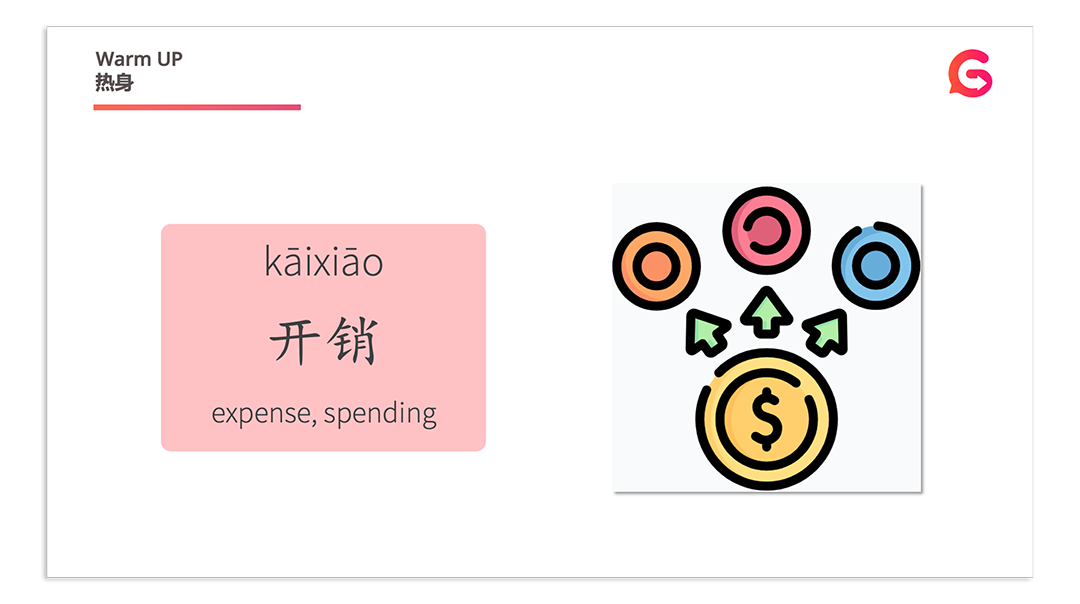
Then we watch a video, in the module about money it was from 我是兰卡, a thirty-something Chinese lady in Shanghai who talks about her life and how she saves and spends money. The speed at which she talks is incredibly high at first, but the teacher will pause, rewind, let us talk — and in the end you can watch the video and understand it.
You could technically do this on your own, but the problem is:
- You need to find the right materials, which have about 90% of the words you already know. You also need to know if the new 10% is actually useful for daily life. Plus the speed and pronunciation need to be challenging but doable.
- The teacher in class will help you pronounce the words correctly and how to use them right. She’s creating many opportunities to speak, to use the words in your situation (such as talking about whether you have a mortgage or not, which expenses you make). This makes you memorize the words better.
We did one class online because of the typhoon this summer. This is part of that recording:
Chinese in the wild
The biggest benefit of real-life Chinese materials is that it’s a more honest reality of learning Chinese. As said above, the speed of the videos is very high, and this course trains you to hear this. People also talk with some slight accents, and there are some distractions like background noises. All this helps you to understand Chinese out of the classroom (and ironically, this perfectly prepares you for the new HSK levels, because high speaking speed, accents & distractions are a requirement of higher levels).
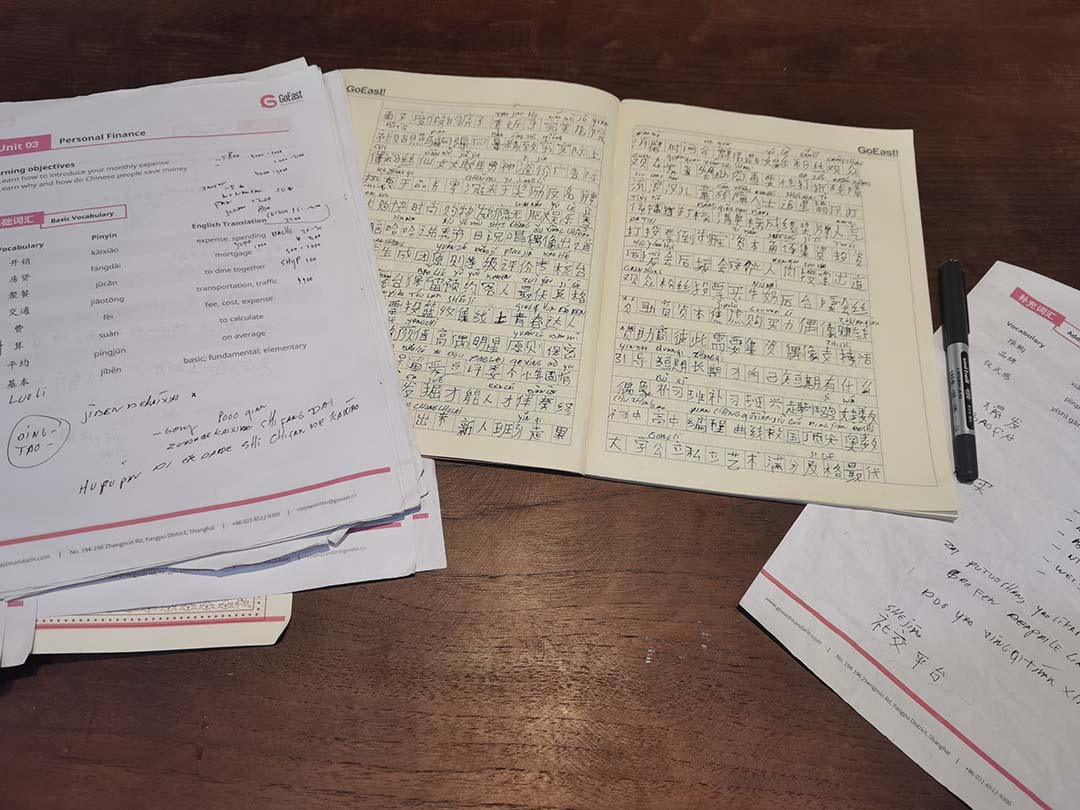
And even though it’s not ordered into categories like HSK, it’s great learning materials, especially if you make notes and repeat the Hanzi characters on your own.
I think the summer course helps if you want to develop your Spoken Chinese. It doesn’t really matter if you finished HSK4 (minimal) or HSK5: the course will still challenge your listening abilities and introduce new vocabulary to you. It could also just be a nice break from the books.