We ask for the old city wall, and the shushu points to the back: “It’s raining, take this way.” And so we go through a garage, kitchen, and up the stairs — and suddenly we’re looking out over a canal and realize we’re on the old wall.
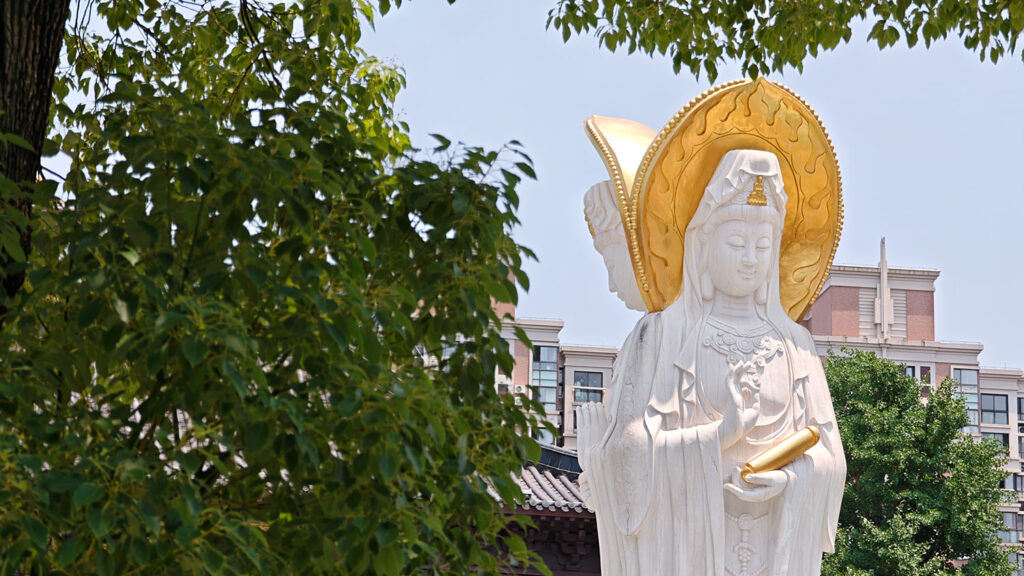
It’s in the back of a huge temple complex in Fengcheng (奉城镇), which is part of Shanghai. The wall looks surprisingly new for one built in 1386, as does the temple (万佛阁, built in 1617). I’m sure these are mostly modern expansions and practical renovations, but apparently an old section of the wall is buried deeper in the ground underneath centuries of dust. The wall we see has a huge gate on one side of the door, but none on the other — although fresh bricks betray the shape of a now-gone opening. One floor above, we find another merlon-lined wall and a tiny canopy, giving shelter to a reclining Buddha. We’re on the north side and on the map, a classic square shape is visible to show the outline of the old town.
It starts raining harder and our shoes are already soaked, and my phone’s auto-focus has trouble taking sharp photos because of the rain.
We drive a bit east to look for Fengcheng’s old street (奉城老街), which is a long street that dates back to 713. On Xiaohongshu (小红书) there’s a photo of an old memorial plaque and we make it our aim to find it. We ask an old yeye about it and he looks up to us — as if I’ve just asked him about a childhood memory. I do imagine he has lived here his whole life, and grew up among these streets. We follow his directions (which are surprisingly accurate) and find the plaque, memorizing soldiers of the Sino-Japanese war that was fought here.
Fengcheng is a nice village, even in the rain. There are lots of old buildings around this old street — all in different styles and different conditions, and also loads of shops — more than you normally see in places this far out of Shanghai.
Sometimes I wonder why I like to visit these places and take photos here. The photos are just a reason to keep looking, I do think it’s something valuable. It all feels like a temporary exhibition, as one day these streets and villages won’t exist anymore. I’m sure other people will take photos, but will they disappear on temporary social platforms, will we be able to find and see them? That is something I don’t control. But this I do.